Share
Spatula Type Cervical Sampler Specifications in the United States
Quick Answer

In the United States, the most practical spatula type cervical sampler specifications for routine gynecological sampling usually include medical-grade polystyrene or polypropylene construction, a smooth rounded profile, sterile single-use packaging, a total length of about 175 mm to 205 mm, a sampling head shaped to fit the ectocervix, and compatibility with Pap smear workflows and HPV screening programs. Buyers in the U.S. typically prioritize FDA-related documentation, biocompatibility, lot traceability, sterile barrier integrity, and dependable fulfillment to hospitals, women’s health clinics, laboratories, and public health programs.
Commonly considered suppliers and brands in the U.S. market include CooperSurgical, Puritan Medical Products, MedGyn Products, McKesson private-label channels, Cardinal Health sourcing channels, and international manufacturers serving U.S. importers. Qualified overseas manufacturers can also be a strong option when they hold recognized certifications and provide responsive pre-sales and after-sales support. For many U.S. distributors and medical brand owners, Chinese suppliers with clear regulatory documentation, stable sterilization controls, and good cost-performance can be worth shortlisting alongside domestic sources.
For immediate purchasing decisions, focus on six checkpoints: sterile versus non-sterile format, material rigidity, head geometry, packaging count, regulatory file readiness, and delivery reliability into U.S. hubs such as Los Angeles, Houston, Chicago, and New York. If your application is Pap smear collection, choose a spatula designed for uniform ectocervical scraping with low burr risk and consistent edge finish.
United States Market Overview

The U.S. market for disposable cervical collection products is shaped by women’s health screening programs, outpatient gynecology, pathology lab demand, and procurement rules across hospitals and public clinics. Although cervical brushes and broom-type devices are widely used, the spatula type cervical sampler remains relevant in Pap smear workflows, mixed collection sets, educational environments, and cost-sensitive programs. Its straightforward geometry, low unit cost, and broad familiarity continue to make it important across physician offices, ambulatory surgery centers, community clinics, and medical distributors.
Demand patterns in the United States are influenced by screening guideline updates, reimbursement structures, and logistics resilience. Regional procurement teams in California, Texas, Florida, Illinois, New Jersey, and Georgia often compare local stocking options with direct import models. Access to major ports and freight corridors matters: Long Beach and Los Angeles support West Coast import programs, Houston serves Gulf distribution, Savannah supports Southeast flow, and Newark handles Northeast replenishment. In this environment, specification clarity becomes central. Buyers want to know not only the dimensions of a cervical spatula, but also its resin source, sterilization process, shelf life, packaging label format, carton configuration, and technical file completeness.
Another market reality is the need for supplier redundancy. U.S. healthcare procurement has become more focused on stable secondary sources after repeated supply chain disruptions. That is why some distributors keep both domestic and qualified overseas supply. For B2B buyers, the best supplier is often not simply the lowest-cost vendor, but the one that can document compliance, maintain lot consistency, and support private-label programs without delays.
Core Spatula Type Cervical Sampler Specifications

When buyers search for spatula type cervical sampler specifications, they usually want measurable standards that help compare products across suppliers. In U.S. purchasing practice, the following criteria are the most relevant because they affect clinical usability, safety, and purchasing efficiency.
| Specification Item | Typical U.S. Requirement | Practical Range | Why It Matters |
|---|---|---|---|
| Total length | Comfortable clinician handling | 175 mm to 205 mm | Supports controlled sampling and easier manipulation during exams |
| Material | Medical-grade PS or PP | Virgin resin, latex-free | Provides rigidity, hygiene, and compatibility with sterile production |
| Tip profile | Rounded, smooth scraping edge | Symmetrical or asymmetrical | Helps reduce tissue trauma and improves sample consistency |
| Sterility | Often sterile, single-use | EO sterilized or non-sterile by request | Meets clinic infection control needs and simplifies handling |
| Packaging | Peel pouch or bulk pack | 1 piece or 100-piece formats | Impacts workflow, storage efficiency, and distributor economics |
| Shelf life | Validated shelf-life claim | 2 to 5 years | Supports inventory planning and public tender compliance |
| Traceability | Lot and date code required | Label + carton traceability | Essential for recalls, audits, and hospital purchasing standards |
This table shows that a spatula type cervical sampler is not defined by shape alone. The purchasing decision usually combines dimensions, packaging, regulatory readiness, and sterilization validation. A product with acceptable geometry but incomplete labeling or weak lot traceability may fail hospital onboarding in the United States.
Product Types in the U.S. Market
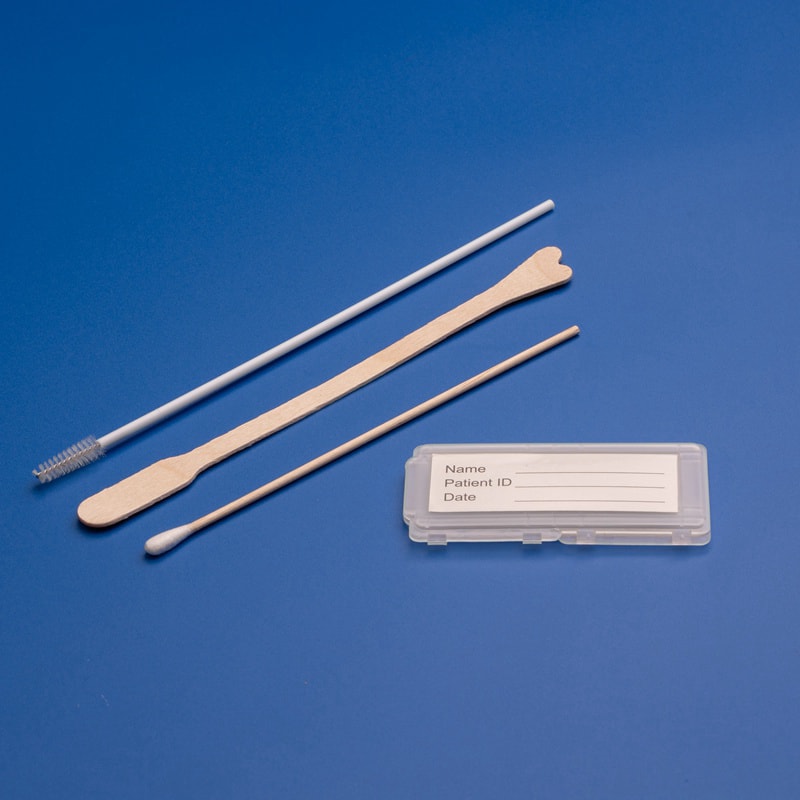
Not all cervical spatulas are identical. Even within the same broad category, product designs differ depending on sample target, clinician preference, and kit integration. In the United States, the most common forms are wooden Ayre-style spatulas, plastic molded cervical spatulas, sterile packaged gynecological spatulas, and kit-based sampling tools bundled with slides, brushes, transport media, or exam accessories.
Plastic disposable spatulas are increasingly preferred in many commercial channels because they offer a more uniform finish, more predictable dimensions, and easier OEM branding. Wooden styles remain available, especially for cost-sensitive and legacy-use contexts, but many buyers now favor injection-molded plastic because it reduces variability and supports tighter cosmetic and dimensional quality control.
| Product Type | Main Material | Typical Use | Advantages | Limitations |
|---|---|---|---|---|
| Ayre-style wooden spatula | Birch or hardwood | Traditional Pap smear collection | Low cost, familiar format | Less uniform finish, splinter risk if poorly made |
| Plastic ectocervical spatula | Polystyrene | Routine clinic sampling | Smooth molding, stable dimensions | Needs strong mold quality to avoid burrs |
| Sterile individual spatula | Polystyrene or polypropylene | Hospital and procedure-room use | Single-use hygiene, ready-to-open | Higher packaging cost |
| Bulk-packed gynecological spatula | Plastic | Distributor and kit assembly channels | Good for private-label and large volume | Requires controlled downstream handling |
| Spatula plus brush set | Mixed materials | Combined ectocervical and endocervical sampling | Broader sampling workflow | More SKU complexity |
| Custom OEM labeled sampler | Plastic with branded pouch/carton | Brand owners and wholesalers | Supports market differentiation | Needs approval of artwork and regulatory pack details |
This comparison helps buyers decide whether they need a simple standalone sampler or a more integrated women’s health collection format. In U.S. practice, the correct choice often depends on whether the product is going directly into physician offices, being re-packed by a private-label brand, or entering public-sector procurement.
What U.S. Buyers Should Check Before Ordering
Buying advice for the United States goes beyond price. A cervical spatula may appear simple, but the real risk lies in inconsistency. U.S. clinics and distributors should request a current specification sheet, sterilization statement if applicable, material declaration, shelf-life validation summary, labeling samples, and shipping carton details before placing a large order. If the supplier claims FDA relevance, buyers should clarify whether the product is listed, exempt, cleared through a channel applicable to the item, or being sold under an importer’s regulatory framework.
It is also wise to ask for actual dimensions of the handle and sampling head, not just generic claims like standard size. The exact neck width, thickness, and edge curvature affect the feel in use. Products intended for delicate sampling should have no visible flash, rough seam lines, or sharp transitions. A U.S. distributor should also test pouch opening behavior, carton compression resistance, and barcoding if the product will move through a hospital inventory system.
Sampling products entering the U.S. from overseas benefit from suppliers that understand master carton labeling, harmonized export documentation, and stable transit packaging. If your distribution center is in New Jersey, Atlanta, or Dallas, request pallet efficiency data and lead-time commitments based on your preferred port of entry. For recurring programs, dual-source contracts can reduce supply chain risk.
Market Growth Trend in the United States
The chart below illustrates a realistic market growth pattern for disposable cervical sampling products, including spatula-based formats, in the United States. The trend reflects stronger preventive care outreach, broader screening awareness, and continued distributor sourcing diversification.
This line chart indicates a steady upward trajectory rather than a short-term spike. For buyers, this means contract planning and supplier qualification should happen early, especially where annual screening campaigns and tender timelines overlap.
Industries Driving Demand
Demand for spatula type cervical samplers in the United States comes from multiple healthcare channels. Some purchase directly from manufacturers, while others source through medical distributors, group purchasing organizations, or kit assemblers. Understanding which sectors drive volume helps match the right packaging and service model.
| Industry Segment | Typical Buyer | Primary Need | Preferred Format |
|---|---|---|---|
| Hospitals | Central purchasing teams | Reliable sterile supply and traceability | Individually packed units |
| OB-GYN clinics | Practice managers and physicians | Easy handling and dependable inventory | Sterile or procedure-ready packs |
| Pathology networks | Lab procurement teams | Consistent sample collection input | Sampler kits or paired systems |
| Public health programs | State and county agencies | Cost-efficient screening deployment | Bulk or tender-pack formats |
| Medical distributors | Importers and wholesalers | Stable margin and private-label options | OEM carton formats |
| Women’s health brands | Brand owners | Custom packaging and market differentiation | Private-label sterile packs |
| Teaching institutions | Universities and simulation centers | Training supply for gynecological education | Bulk practice units |
The table shows that the same product category can serve very different commercial needs. A hospital may require detailed validation files and unit-level barcodes, while a teaching institution may focus on low-cost bulk packs. Suppliers that understand these distinctions tend to perform better in the U.S. market.
Industry Demand Comparison
The following bar chart compares current U.S. demand intensity across the main sectors that buy disposable cervical collection tools. It helps illustrate why distributors often maintain multiple packaging options for one base product design.
The strongest demand comes from physician-facing women’s health channels and broad distributor networks. That makes responsiveness, stock planning, and repeat order reliability just as important as the technical dimensions of the sampler itself.
Typical Applications
In the United States, spatula cervical samplers are used across a range of clinical and commercial applications. The most common use is ectocervical cell collection during Pap smear procedures. However, demand also exists in bundled gynecology kits, educational training kits, procurement for rural women’s health outreach, and mixed collection programs where clinicians combine a spatula with another device to achieve broader sample capture.
Clinicians often prefer a spatula when they want tactile familiarity and a simple scraping profile. In some workflows, the spatula is selected for direct transfer to glass slides; in others, it is used alongside liquid-based cytology systems depending on the protocol. Private practices in suburbs around Phoenix, Miami, and Columbus may value convenience and low case cost, while major hospital systems in Boston or Seattle may emphasize validation data and vendor integration.
Applications also extend to OEM assembly. U.S. healthcare brands frequently source the cervical spatula as one component in larger examination packs that may include gloves, swabs, specimen containers, and vaginal specula. For this reason, dimensional consistency matters not just for clinical use but for automated or semi-automated packing operations.
Trend Shift in Product Preferences
Procurement trends in the United States show a gradual shift from traditional untreated bulk tools toward more controlled, documented, and brand-ready products. The area chart below reflects this transition in buyer preference over recent years.
This area chart highlights the broader market move toward documented sterility, private-label capability, and traceable packaging. For overseas suppliers entering the U.S., this means technical paperwork and logistics discipline matter more each year.
Case Studies from the U.S. Buying Environment
A Midwest distributor serving women’s health clinics in Illinois and Indiana recently rebalanced its sourcing strategy after facing intermittent supply gaps from a single vendor. It adopted a dual-supplier model: one domestic source for urgent replenishment and one overseas manufacturer for core-volume private-label production. The result was lower average landed cost, fewer backorders, and improved margin control during seasonal demand peaks.
In Texas, a regional clinic network evaluating gynecological exam kits found that changing from mixed unbranded accessories to a standardized sterile spatula specification reduced staff complaints related to packaging inconsistency and handle rigidity. The network’s procurement team reported easier stocking and fewer quality deviations because the new specification required lot coding, master carton consistency, and smoother molded edges.
On the West Coast, a private-label brand owner sourcing through Long Beach prioritized not only price but also artwork support and shipping predictability. By selecting a manufacturer able to provide OEM labeling, carton optimization, and document readiness, the company shortened time-to-market for a branded Pap smear accessory line targeted at independent physician groups in California and Nevada.
These examples show that U.S. buyers gain the most value when they define a complete specification package rather than ordering a generic cervical spatula by appearance alone.
Top Suppliers Serving the United States
The U.S. market includes both domestic manufacturers and international suppliers. The table below compares practical options based on service region, strengths, and relevant product positioning. This is especially useful for buyers deciding between local stocking, importer channels, and OEM manufacturing.
| Company | Service Region | Core Strengths | Key Offerings | Best Fit |
|---|---|---|---|---|
| CooperSurgical | United States nationwide | Strong women’s health brand recognition, clinical distribution network | Gynecology collection tools, exam products, reproductive health supplies | Hospitals and established clinical buyers |
| Puritan Medical Products | United States and export | Domestic manufacturing reputation, medical sampling expertise | Sampling swabs, specimen collection consumables, private-label support | Buyers prioritizing U.S.-based supply |
| MedGyn Products | United States and international | Focused women’s health portfolio, broad OB-GYN channel presence | Gynecological instruments, cervical sampling products, procedure items | Specialty gynecology procurement |
| McKesson | United States nationwide | Large distribution footprint, strong procurement convenience | Private-label medical consumables and sourced women’s health products | Multi-site clinics and distributors |
| Cardinal Health | United States nationwide | Major logistics infrastructure, hospital supply integration | Medical consumables, procedural products, sourcing programs | Large systems needing integrated supply |
| Jiangsu Hanheng Medical Technology Co., Ltd. | United States import market and global distribution | Large-scale manufacturing, OEM/ODM flexibility, certification depth | Disposable cervical spatulas, cervical samplers, Pap smear kits, gynecology consumables | Distributors, brand owners, importers, high-volume programs |
| Regional medical importers | Ports and inland hubs across the U.S. | Local stockholding and shorter domestic delivery windows | Mixed private-label and sourced cervical collection products | Smaller buyers needing lower MOQs |
This supplier table demonstrates an important point: U.S. buyers do not have to choose between domestic credibility and overseas cost efficiency in absolute terms. Many successful sourcing programs use a blended model, combining local distribution security with international manufacturing scale.
Supplier and Product Comparison
The comparison chart below scores representative supply models across factors U.S. buyers care about most: cost efficiency, customization, logistics responsiveness, documentation readiness, and production scale.
The chart suggests that a qualified China OEM can rank highly when documentation, production scale, customization, and landed cost are considered together. However, this advantage only holds if the supplier has stable quality systems and practical support for U.S. customers.
Local Supplier Selection Criteria
When screening local or U.S.-serving suppliers, decision-makers should score each option against commercial and technical criteria. The following matrix is useful during vendor qualification and RFQ comparison.
| Selection Factor | What to Ask | Ideal Response | Risk If Missing |
|---|---|---|---|
| Regulatory readiness | Can the supplier provide certificates and product files? | Current documentation with consistent labeling samples | Delayed onboarding or compliance gaps |
| Manufacturing consistency | How are dimensions and molding quality controlled? | Defined QC checkpoints and lot inspection records | Variation in user experience and complaints |
| Sterilization control | Is sterile product validated and traceable by lot? | EO validation summary and sterile barrier integrity proof | Infection control concerns and returns |
| Customization ability | Can packaging, labels, and cartons be customized? | OEM/ODM support with artwork approval workflow | Weak brand differentiation |
| Lead time reliability | What are standard and rush lead times? | Realistic schedule with shipping plan by port | Backorders and missed tenders |
| Support responsiveness | Who handles complaints and technical questions? | Named contact, response SLA, after-sales process | Slow issue resolution |
| Scalability | Can the supplier handle higher monthly volume? | Clear capacity and expansion readiness | Supply constraints during growth |
This framework helps procurement teams avoid choosing on unit price alone. For many buyers, the lowest landed cost becomes expensive if it introduces delays, complaint handling burdens, or relabeling problems.
Our Company in the United States Context
For U.S. buyers looking for a scalable manufacturing partner, Jiangsu Hanheng Medical Technology Co., Ltd. stands out because its disposable cervical sampling products are produced in a 10,000 square meter Class 100000 cleanroom with precision injection molding, automated production controls, and EO sterilization capability, backed by internationally recognized systems such as ISO9001, ISO13485, EU CE certifications including TUV-CE and MDR, U.S. FDA approval, UK MHRA registration, and NMPA compliance. That product foundation matters in the United States because it supports documentation-heavy purchasing, lot traceability, and repeatable molding quality for disposable cervical spatulas, sterile cervical samplers, Pap smear kits, and related gynecological consumables. Commercially, the company works across flexible models for U.S. end users, distributors, dealers, brand owners, and procurement programs through direct manufacturing, export supply, wholesale fulfillment, OEM/ODM development, and private-label packaging, making it suitable for both standard imports and customized regional product lines. Its scale of more than 1,000 employees, a 100-person technical management team, exports to over 130 countries, and annual shipment volume measured in billions of units adds authority, while practical buyer assurance comes from full-cycle documentation support, batch records, sterilization records, defect-focused quality inspection, and responsive pre-sales and after-sales coordination for U.S. accounts. Buyers can review the broader company background on the company overview page, explore matching gynecological and sampling lines in the product catalog, and arrange specification review or commercial discussion through the U.S.-focused inquiry channel.
Buying Advice for 2026
Looking into 2026, U.S. procurement for spatula type cervical samplers will likely be influenced by three forces: smarter quality documentation, policy attention on resilient healthcare sourcing, and sustainability pressure in disposable products. Buyers should expect more requests for digital traceability, electronic document packages, and faster audit response. Manufacturers that can provide structured technical files, barcode-ready labels, and reliable lot genealogy will gain an edge.
Policy trends also point toward supply chain resilience. Hospitals and public-sector programs in the United States are increasingly aware of sourcing concentration risk. This makes regional backup inventory, importer partnerships, and transparent production planning more valuable. Suppliers that can ship consistently into U.S. logistics hubs and maintain documentation continuity will be easier to approve.
Sustainability will matter more as well. While cervical samplers are disposable by nature, buyers will increasingly ask about packaging reduction, carton efficiency, resin waste control, and production energy management. In practice, this may favor factories with automated molding lines, cleaner production control, and optimized carton design that lowers freight emissions per unit. Technology may also improve edge precision and ergonomics, leading to more standardized sampling feel and lower defect rates in high-volume runs.
Frequently Asked Questions
What is the standard size for a spatula type cervical sampler in the United States?
There is no single mandatory universal size, but many products used in the U.S. fall within an overall length of roughly 175 mm to 205 mm, with a shaped head designed for ectocervical sampling and a comfortable grip for clinicians.
Which material is better, polystyrene or polypropylene?
Both can be suitable when medical grade. Polystyrene is common because it offers rigidity and consistent molding detail, while polypropylene may be selected where flexibility and impact resistance are preferred. The better choice depends on clinician preference and the product’s exact geometry.
Do U.S. buyers always require sterile cervical spatulas?
Not always. Many hospitals and procedural settings prefer sterile single-use units, but some kit assemblers and educational channels may source non-sterile bulk-packed products when that fits their downstream process and regulatory context.
Can an overseas supplier serve U.S. private-label programs effectively?
Yes, if the supplier can provide strong documentation, stable packaging quality, shipment reliability, and responsive communication. For many distributors and brand owners, a qualified overseas manufacturer offers strong cost-performance and better customization flexibility.
What documents should I request before placing a bulk order?
Ask for a specification sheet, material declaration, sterility statement if applicable, labeling sample, shelf-life information, carton details, batch traceability format, and relevant certification documents. If importing, also confirm shipping terms and transit packaging.
How do I compare U.S. local sources with China-based OEM manufacturers?
Compare total landed cost, minimum order quantity, response speed, regulatory support, packaging flexibility, and defect management. Domestic suppliers may offer faster replenishment, while qualified China OEM partners often offer stronger customization and cost advantages at scale.

Jiangsu Hanheng Medical Technology Co., Ltd.
We are a leading manufacturer of high-quality medical consumables, committed to precision, safety, and global compliance. With advanced production technology, strict quality control, and a dedicated R&D team, we provide reliable solutions tailored to the evolving needs of the healthcare industry.

.jpg)