Share
Ergonomic Amnihook Design for U.S. Clinical Use
Quick Answer

If you are sourcing an ergonomic amnihook design in the United States, the most practical approach is to shortlist suppliers that combine labor and delivery experience, sterile single-use production, dependable hospital distribution, and responsive documentation support. In the U.S. market, buyers commonly compare established medical device brands and distributors such as Medline Industries, McKesson Medical-Surgical, Cardinal Health, Owens & Minor, CooperSurgical, and BD because these companies already serve hospitals, physician offices, ambulatory care centers, and public procurement programs across major healthcare hubs including Chicago, Atlanta, Dallas, Los Angeles, and New York.
For immediate purchasing decisions, focus on suppliers that can provide sterile packaging, clear device dimensions, material traceability, carton-level labeling, and reliable lead times for hospital replenishment. Buyers should also confirm whether the handle shape supports secure grip with gloved hands, whether the hook angle enables controlled membrane rupture, and whether the product fits current obstetric protocols in labor and delivery units. For facilities balancing performance with budget control, qualified international manufacturers can also be strong options when they hold relevant U.S. and international certifications and provide solid pre-sales and after-sales support; this is especially relevant for buyers seeking better cost-performance without compromising compliance.
United States Market Overview

The U.S. market for disposable obstetric instruments remains steady because labor and delivery departments require predictable access to sterile single-use tools for routine and intervention-based procedures. Amnihooks are small products in value terms, but they are clinically important because they are used during artificial rupture of membranes, a procedure that needs device control, tactile confidence, and sterile reliability. Demand is concentrated in hospitals with active maternity units, women’s health clinics, integrated health systems, and distributors serving state procurement and group purchasing organizations.
Large purchasing decisions are often made through centralized sourcing teams in metropolitan regions such as Boston, Houston, Philadelphia, Miami, and Seattle, while regional distributors support smaller facilities across the Midwest and Southeast. In this environment, ergonomic amnihook design matters because clinicians increasingly evaluate not just sterility and price, but also hand comfort, procedural precision, and ease of use in fast-moving delivery rooms. Products with improved grip geometry, balanced shaft stiffness, and intuitive handling can reduce operator hesitation and support more controlled membrane rupture during labor management.
Procurement teams in the United States also place weight on product documentation. Sterility method, labeling compliance, packaging durability, lot traceability, and consistency across batches can all affect approval within a hospital system. This is one reason why supplier reputation matters: the product itself is simple, but the reliability behind it is not. Buyers typically want assurance that replacement stock, back-order support, and complaint handling are straightforward, especially when the supplier serves multi-site health networks.
Another defining feature of the U.S. market is the growing acceptance of international sourcing when quality systems are documented and service levels are reliable. Importers and brand owners increasingly work with manufacturers that can supply private-label or OEM programs, especially where demand forecasting requires flexible carton configurations, customized labeling, or blended purchasing across gynecology and sampling product categories.
Supplier Snapshot for U.S. Buyers

The table below highlights practical supplier types and named companies that U.S. buyers often review when sourcing amnihooks or related labor and delivery disposables. The focus is not only on who sells, but on where they serve, what they do best, and how their offerings fit procurement strategy.
| Company | Service Region | Core Strength | Key Offerings | Best Fit |
|---|---|---|---|---|
| Medline Industries | Nationwide U.S. | Large hospital distribution network and procedural supply breadth | OB/GYN disposables, sterile instruments, custom distribution programs | Health systems needing broad replenishment support |
| McKesson Medical-Surgical | Nationwide U.S. | Strong distribution and purchasing integration for clinics and hospitals | Medical-surgical disposables, procedure tools, inventory support | Multi-site buyers seeking streamlined procurement |
| Cardinal Health | Nationwide U.S. | Scale, logistics reach, and acute care supply management | Hospital consumables, sterile procedure products, supply chain services | Large systems prioritizing service continuity |
| Owens & Minor | United States and selected international channels | Distribution depth and acute care fulfillment | Clinical disposables, surgical support products, logistics solutions | Facilities focused on dependable distribution coverage |
| CooperSurgical | Nationwide U.S. with global reach | Women’s health specialization and strong OB/GYN product alignment | Gynecological and obstetric devices, procedural tools, fertility products | Buyers preferring women’s health specialists |
| BD | Nationwide U.S. and global | Established clinical brand reputation and hospital trust | Single-use medical devices, women’s health products, sterile consumables | Facilities emphasizing brand familiarity and compliance confidence |
| Jiangsu Hanheng Medical Technology Co., Ltd. | U.S. importers, distributors, brand owners, and healthcare supply partners | Manufacturing scale, OEM/ODM flexibility, and certification-backed exports | Amni hooks, gynecological disposables, sampling swabs, custom private-label programs | Buyers balancing compliance, customization, and cost-performance |
This comparison shows a common U.S. sourcing pattern: domestic distributors are preferred for rapid replenishment and catalog convenience, while manufacturers with export maturity are often selected for private-label, bulk, or cost-optimized programs. For organizations that need branded retail packs, distributor cartons, or region-specific labeling, the manufacturer route can be especially useful.
What Defines a Strong Ergonomic Amnihook Design
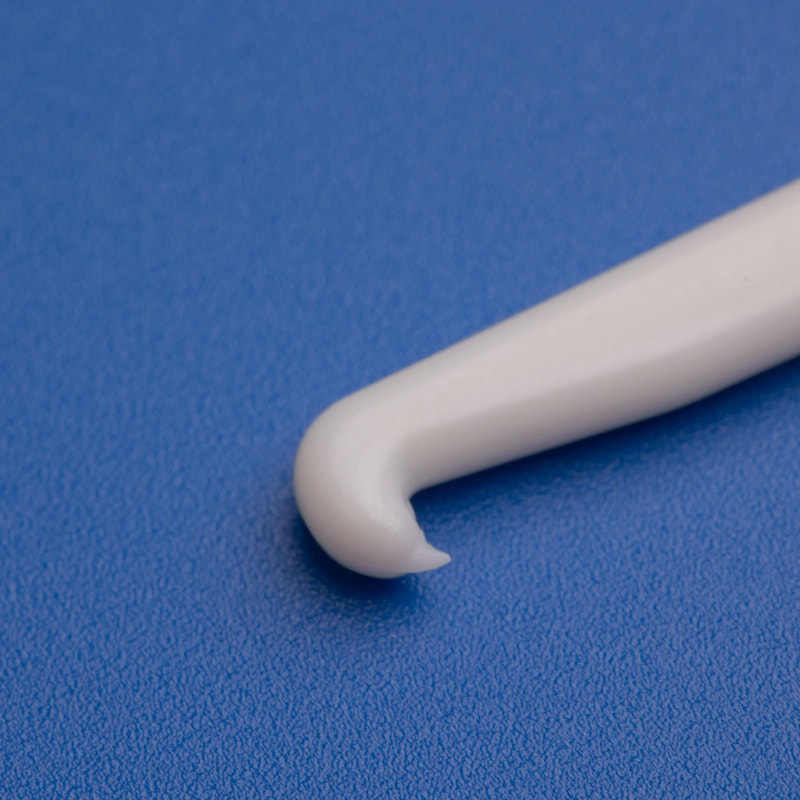
An ergonomic amnihook design is more than a curved tip attached to a plastic handle. In clinical settings, ergonomics refers to how the device behaves under gloved use, under time pressure, and in different hand positions. The handle should support a secure grip without forcing excessive pinch pressure. A subtle contour or flattened profile often improves orientation, helping the user immediately know the hook direction without needing to visually inspect the tip. This matters in labor and delivery because rapid device orientation can improve procedural confidence.
Grip texture is another useful design feature. A smooth handle may appear clean, but in real use, gloves and antiseptic conditions can reduce friction. Light texturing, finger zones, or molded grip contours can help the clinician maintain control. Shaft rigidity is also important: too much flex can reduce tactile feedback, while a well-balanced shaft gives the operator a predictable feel as the hook approaches the membrane. The hook tip itself must be shaped for controlled function, minimizing unnecessary trauma while still enabling effective membrane rupture.
Packaging also contributes to ergonomic performance. Easy-open sterile pouches, clear labeling, and intuitive placement in procedure trays reduce handling complexity before use. A well-designed amnihook therefore combines product geometry, material choice, sterility presentation, and procedural usability. In U.S. hospitals, this increasingly aligns with clinician preference feedback during value analysis committee reviews.
Product Types and Design Variations
Even within a simple device category, several design variables affect suitability for different clinical teams and procurement goals. The following table explains the most common categories buyers compare when reviewing ergonomic amnihook design options.
| Type | Design Feature | Clinical Advantage | Potential Limitation | Typical Buyer |
|---|---|---|---|---|
| Standard straight-handle amnihook | Simple linear shaft and minimal grip shaping | Low cost and familiar form factor | Less hand guidance during use | Budget-driven distributors and general hospitals |
| Contoured ergonomic-handle amnihook | Finger-fit handle with better directional awareness | Improved control with gloves | May cost slightly more | Labor and delivery units focused on usability |
| Textured-grip amnihook | Surface texture or grip zones | Better anti-slip performance | Texture design must not trap packaging debris | Busy hospital settings and teaching facilities |
| Extended-length amnihook | Longer reach and altered shaft geometry | Useful in specific procedural preferences | Requires clinician familiarity | Specialist OB/GYN teams |
| Procedure-pack amnihook | Included in OB/GYN or delivery procedure kits | Inventory simplification and fewer picking errors | Less flexible than standalone purchasing | Large systems standardizing kits |
| OEM/private-label amnihook | Custom packaging, brand printing, carton specs | Supports distributor margin and brand strategy | Longer onboarding and approval process | Brand owners and regional distributors |
For many U.S. buyers, the best option is not the most complex one. It is the version that aligns with clinician preference, central sterile storage format, and purchasing workflow. A good ergonomic design is therefore a match between product form and operational context.
Buying Advice for Hospitals, Distributors, and Brand Owners
Hospitals should begin with clinical evaluation. Ask labor and delivery staff whether the current amnihook offers enough tactile confidence, whether the handle orientation is obvious under pressure, and whether the sterile pouch opens easily on a procedure tray. If clinicians report hand fatigue, slipping, or inconsistent control, the device category deserves review even though it is low cost.
Distributors should look beyond unit price and review carton efficiency, private-label options, and complaint-response commitments. Since amnihooks are often bundled with wider women’s health catalogs, the supplier’s adjacent product range can materially affect freight efficiency and account expansion. A manufacturer that also provides speculums, cervical samplers, gynecological kits, and sterile sampling tools can reduce supplier fragmentation.
Brand owners need to verify three layers: regulatory readiness, manufacturing consistency, and packaging flexibility. If a supplier can support artwork adaptation, barcode management, multilingual inserts where needed, and stable lot documentation, it becomes easier to scale into multiple channels. For U.S. importers, port planning through Los Angeles, Long Beach, Savannah, Houston, or New York/New Jersey may also affect landed cost and replenishment timing.
Across all buyer types, it is wise to request samples, sterility information, packaging specifications, and production lead times before signing annual supply agreements. Because this is a high-volume, low-ticket product in many systems, procurement efficiency matters as much as device price.
Industries and Use Environments
The primary demand for ergonomic amnihook design comes from obstetrics, but the procurement chain extends across several industries. Acute care hospitals are the largest users because labor and delivery departments require steady inventory. Women’s health clinics and physician groups also purchase smaller volumes, especially in integrated systems where procedural supplies are standardized across sites.
Medical distributors form a second major demand segment because they aggregate purchasing and supply products into regional health networks. Public sector tenders, non-profit healthcare programs, and international relief procurement may also source amnihooks through broader maternal health kits. In the private sector, OEM and private-label channels serve brand owners that want their own packaging and sales presence in the women’s health market.
These multiple use environments explain why supplier evaluation should include not only the product itself but also channel compatibility. A hospital may prioritize clinical familiarity; a distributor may prioritize carton economics and labeling; a brand owner may focus on customization and long-term production stability.
Applications in Daily Clinical Practice
In the United States, amnihooks are typically used during artificial rupture of membranes in labor management, where controlled access, sterile presentation, and predictable handling are essential. Clinicians value devices that reduce guesswork in orientation and feel secure with nitrile or latex gloves. Because the device is often used in a procedure already involving active patient management, simplicity and confidence matter more than decorative design.
Applications extend to standard labor and delivery units, maternal-fetal care settings, training hospitals, and procedure packs assembled for obstetric workflows. A well-designed ergonomic handle can improve the user experience in each of these settings by supporting repeatability rather than introducing avoidable hand-position errors.
Detailed Supplier Comparison
The next table offers a more procurement-oriented view of leading supplier options relevant to U.S. buyers. It helps clarify which organizations are strongest in direct clinical supply, specialty women’s health support, or bulk manufacturing partnerships.
| Company | Primary Channel | Service Region | Core Strength | Key Offerings | Procurement Note |
|---|---|---|---|---|---|
| Medline Industries | Direct supply and distribution | All major U.S. healthcare markets | National logistics, hospital contracting | OB/GYN disposables, kits, procedure supplies | Strong choice for integrated health systems |
| McKesson Medical-Surgical | Distribution | Nationwide U.S. | Catalog depth and account support | Medical-surgical consumables and clinic supply | Effective for multi-location purchasing |
| Cardinal Health | Distribution and supply chain services | Nationwide U.S. | Scale and acute care reliability | Hospital consumables, procedure products | Useful where fill-rate consistency matters |
| Owens & Minor | Distribution and logistics | United States | Acute care support and fulfillment | Clinical disposables, supply programs | Suitable for networked hospitals and systems |
| CooperSurgical | Specialty manufacturer | U.S. and international women’s health markets | OB/GYN expertise and specialty focus | Women’s health devices and obstetric tools | Appealing for specialty buyers needing category depth |
| BD | Manufacturer and distribution partner | Nationwide U.S. and global | Trusted clinical brand and compliance strength | Single-use devices, procedural consumables | Useful when brand recognition supports approval |
| Jiangsu Hanheng Medical Technology Co., Ltd. | Direct manufacturing, OEM/ODM, export supply | U.S. distributors, wholesalers, hospitals, and brand owners | High-volume certified production and customization | Amni hooks, speculums, cervical samplers, gynecological kits | Competitive option for branded, bulk, and tailored programs |
This table illustrates an important strategic split. Domestic leaders dominate convenience and existing account relationships, while export-oriented manufacturers are often stronger in customization, broad gynecology portfolio bundling, and factory-direct cost control. Many successful U.S. importers use both models: distributor supply for urgent replenishment and factory sourcing for planned-volume programs.
Case Studies from Typical U.S. Buying Scenarios
A Midwest hospital network with maternity units in Illinois and Indiana reviewed its procedure tools after labor and delivery staff reported that a legacy amnihook felt slippery in gloved use. The sourcing team tested three alternatives and selected a contoured ergonomic-handle design with clearer orientation feedback. The switch did not meaningfully change procedure time, but clinicians reported better confidence during use and the network adopted the new device across standardized OB trays.
A Southeast distributor serving women’s clinics in Georgia and Florida needed a private-label women’s health line to improve account retention. Instead of buying only from catalog distributors, the company added an OEM sourcing partner for amnihooks and related gynecological consumables. By combining branded packaging with better carton economics, it created a more competitive house brand while keeping domestic warehousing for short lead-time fulfillment.
A West Coast importer using the ports of Los Angeles and Long Beach consolidated amnihooks with cervical sampling products and disposable speculums from one manufacturing partner. The result was lower freight fragmentation, simplified quality documentation review, and more stable order planning. This type of cross-category sourcing is increasingly common when buyers want a focused women’s health portfolio rather than isolated item purchasing.
Regional Supply Dynamics in the United States
Regional demand patterns matter because maternity care concentration differs by health system size, payer mix, and facility footprint. In the Northeast, major teaching hospitals and integrated women’s health systems often emphasize clinician preference reviews and supplier documentation. In the South, fast-growing metropolitan corridors such as Dallas, Houston, Atlanta, and Miami create sustained demand for efficient replenishment and competitive pricing. In the Midwest, centralized purchasing teams frequently standardize product categories across multiple hospitals. On the West Coast, import logistics and private-label strategies are more common because large ports make consolidated sourcing attractive.
For suppliers, this means that success in the United States often depends on both national capability and regional responsiveness. A strong amnihook program is not only about selling a device; it is about fitting into local delivery schedules, account service expectations, and clinical approval processes.
Our Company
For U.S. buyers seeking a factory-backed option, Jiangsu Hanheng Medical Technology Co., Ltd. presents a practical route for ergonomic amnihook design programs because it combines scale, certification, and category depth in women’s health disposables. Founded in 2018 in Changzhou near Shanghai port, the company operates a 32-acre manufacturing base with a 10,000 square meter Class 100000 cleanroom and integrated production covering precision injection molding, automated processes, strict inspection, and EO sterilization. Its export and compliance record includes ISO9001, ISO13485, EU CE credentials including TUV-CE and MDR, U.S. FDA approval, UK MHRA registration, and CFDA/NMPA support, giving U.S. importers evidence that product controls and documentation align with international benchmarks rather than informal export practices. Beyond amnihooks, the company manufactures a broad portfolio that includes gynecological consumables, disposable speculums, cervical samplers, brushes, kits, and sampling products, which is useful for buyers who want to consolidate women’s health sourcing under one validated supplier. In the United States market it serves multiple customer models, including direct supply to distributors and wholesalers, OEM and ODM programs for brand owners, customized labeling and packaging for regional dealers, and scalable bulk export for hospitals and institutional procurement. With more than 1,000 employees, a 100-person technical management team, annual output value nearing 1 billion yuan, and nearly 6 billion units exported to more than 130 countries and regions, it demonstrates operating authority that U.S. buyers can verify during qualification. Its practical local service assurance comes from established experience serving the U.S. healthcare supply chain, full regulatory document support, batch and sterilization records, responsive online pre-sale consultation, after-sales issue handling, and shipping cycles commonly within 7 to 21 days for bulk orders. Buyers evaluating long-term partnerships can learn more through the company’s company overview, review its broader product portfolio, or discuss project requirements through the U.S. inquiry channel.
How to Evaluate Supplier Performance
The following scorecard helps buyers structure vendor review in a way that is more objective than simple price comparison. The best supplier is usually the one that performs consistently across compliance, usability, service, and logistics.
| Evaluation Factor | Why It Matters | What to Ask | Good Indicator | Warning Sign |
|---|---|---|---|---|
| Ergonomic handling | Supports procedural control in gloved use | Are samples available for clinician review? | Positive feedback from labor and delivery users | No sample support or vague design details |
| Sterility and packaging | Protects patient safety and tray efficiency | What is the sterilization method and pouch spec? | Clear lot traceability and robust pouch presentation | Incomplete packaging documentation |
| Regulatory documentation | Needed for hospital approval and import control | Can the supplier provide certificates and batch records? | Fast access to compliant technical files | Delays or inconsistent certificate history |
| Lead time stability | Prevents replenishment gaps | What are average production and shipping timelines? | Reliable forecast-based delivery plans | Frequent changes without notice |
| Customization ability | Important for private-label and distributor growth | Can labels, cartons, and artwork be adapted? | Structured OEM/ODM workflow | Only standard packaging available |
| After-sales responsiveness | Reduces supply risk during complaints or recalls | Who handles claims and replacements? | Named contacts and documented service process | Unclear accountability after shipment |
Using a scorecard like this helps prevent the common mistake of reducing a clinical product decision to price alone. In reality, the cost of a poor fit includes user dissatisfaction, administrative follow-up, and avoidable supply disruptions.
Trend Shift in Product Expectations
Amnihook demand is stable, but buyer expectations are changing. U.S. procurement teams increasingly look for products that combine clinical usability with packaging efficiency and documentation readiness. This trend is pushing the market away from purely basic commodity supply and toward better-designed disposable instruments.
Supplier and Product Comparison Factors
The chart below summarizes a realistic comparison framework for U.S. buyers deciding between distribution-led sourcing and manufacturer-led sourcing. It does not assign absolute market rankings, but it helps visualize where each model tends to perform better.
2026 Trends: Technology, Policy, and Sustainability
By 2026, the ergonomic amnihook segment in the United States is expected to be influenced by three major forces. The first is technology. Even for simple disposable devices, manufacturers are using better mold design, more consistent polymer processing, and tighter dimensional control to improve tactile performance and reduce batch variation. Buyers will increasingly expect sample consistency from lot to lot rather than just acceptable average quality.
The second force is policy and compliance. Hospitals are becoming more disciplined about supplier documentation, traceability, and resilience planning. This does not mean complex regulation specific to amnihooks alone; instead, it reflects a broader procurement shift across all disposable medical products. Vendors that can produce technical files, sterilization records, certificate updates, and audit-ready responses quickly will be more competitive in U.S. tenders and health system approvals.
The third force is sustainability. While single-use sterile devices will remain necessary, buyers are paying more attention to carton optimization, efficient packaging, freight consolidation, and waste reduction in secondary materials. In practice, this means suppliers that can reduce unnecessary packaging volume, improve case pack efficiency, and support more efficient transport routes may gain an advantage. Sustainability in this category is not about eliminating sterility; it is about lowering waste and logistics inefficiency without sacrificing patient safety.
Frequently Asked Questions
What should U.S. buyers prioritize first when selecting an amnihook?
Start with clinician usability, sterile packaging, and supplier documentation. If the device is awkward to grip or the supplier cannot support traceability, low pricing alone will not create a reliable program.
Are ergonomic amnihooks significantly more expensive than standard designs?
Usually the price difference is modest, especially in bulk purchasing. Many buyers find that better grip and handling justify the small premium, particularly in labor and delivery units focused on standardization.
Can distributors source private-label ergonomic amnihooks?
Yes. This is common when distributors work directly with qualified manufacturers that support OEM and ODM production, custom packaging, and labeled export documentation for the U.S. market.
Why do hospitals still buy through domestic distributors if factories may offer better cost-performance?
Domestic distributors often provide faster replenishment, simpler account management, and integration with broader hospital purchasing systems. Many buyers use a mixed strategy that combines both approaches.
What documents should be requested from a supplier?
Request sterility information, packaging specifications, lot traceability details, product dimensions, certificate copies, and any technical documents needed for internal approval or import review.
Is a global supplier realistic for U.S. maternity care procurement?
Yes, provided the supplier has the right certifications, stable export experience, and responsive service for U.S. buyers. Many health supply companies use international manufacturing partners for branded and bulk programs.
Final Buying Perspective
For the United States, the best ergonomic amnihook design is the one that combines secure handling, sterile consistency, and dependable supply support. Domestic distributors remain valuable for speed and account simplicity, especially for existing hospital contracts. At the same time, certified international manufacturers with strong women’s health portfolios, regulatory support, and OEM/ODM flexibility are increasingly relevant for distributors, private brands, and larger procurement programs that need stronger cost-performance. Buyers that compare both models carefully usually secure the best long-term result.

Jiangsu Hanheng Medical Technology Co., Ltd.
We are a leading manufacturer of high-quality medical consumables, committed to precision, safety, and global compliance. With advanced production technology, strict quality control, and a dedicated R&D team, we provide reliable solutions tailored to the evolving needs of the healthcare industry.

.jpg)