Share
Best Flocked Swabs for Rapid Antigen Test in the United States
Quick Answer

If you need flocked swabs for rapid antigen test programs in the United States, the most practical approach is to compare established diagnostic and specimen-collection suppliers with strong regulatory documentation, stable inventory, and fast domestic fulfillment. For hospital systems, labs, distributors, and public health procurement teams, the most relevant names commonly considered include Puritan Medical Products, Copan Diagnostics, Thermo Fisher Scientific, Cardinal Health, Medline Industries, and MWI Animal Health for veterinary and field applications. These companies are widely recognized for specimen collection products, transport compatibility, and supply-chain reliability across major US markets such as Boston, San Diego, Chicago, Atlanta, and Dallas.
For buyers focused on cost control at scale, qualified international manufacturers can also be worth evaluating when they hold relevant certifications and provide clear regulatory files, consistent sterilization records, and dependable support. In practice, many US importers and private-label buyers also consider experienced Chinese manufacturers with CE, ISO 13485, FDA-related documentation support, and responsive pre-sales and after-sales teams because they can offer strong cost-performance for distributor, OEM, and government tenders.
The best choice depends on your use case: rigid clinical validation needs often favor suppliers already integrated into US diagnostic channels, while large-volume screening, retail kit assembly, and private-label projects may benefit from flexible OEM/ODM manufacturing, custom packaging, and lower landed costs. Before ordering, confirm swab tip material, breakpoint design, sterility method, packaging format, assay compatibility, and lead time from port to final warehouse.
United States Market Overview

The United States remains one of the most important markets for rapid antigen testing supplies because procurement is spread across hospitals, physician office labs, pharmacy chains, urgent care groups, schools, occupational health providers, government agencies, distributors, and e-commerce diagnostic brands. Even as emergency-pandemic buying has normalized, demand for flocked swabs for rapid antigen test collection remains relevant in respiratory testing, decentralized screening, institutional outbreak response, and home-health oriented kit assembly. The market is shaped by several geographic procurement hubs: California supports biotech and diagnostics imports through Los Angeles and Long Beach; the Northeast, especially Massachusetts and New Jersey, anchors many clinical and distribution networks; the Midwest relies heavily on Chicago warehousing; and Texas and Georgia function as high-volume redistribution points for national programs.
In the US, buyers usually evaluate swabs through a risk-management lens rather than by unit price alone. They ask whether the product is sterile, whether the shaft geometry fits the target nostril depth and collection protocol, whether the swab is compatible with extraction buffers used in antigen kits, and whether the supplier can provide lot traceability, biocompatibility information, packaging integrity data, and on-time replenishment. This is especially important when swabs are sold as stand-alone consumables or integrated into customized testing kits.
Another defining feature of the US market is channel diversity. Some buyers purchase direct from manufacturers; others buy through GPO-linked distributors, regional medical supply houses, or contract packaging firms that assemble complete kits. This creates room for both domestic manufacturers and overseas producers with robust compliance and logistics capabilities. In large tenders, service quality often matters as much as price, including the ability to answer technical questions, provide samples quickly, update carton labels, and maintain communication during customs clearance.
The line chart reflects a realistic post-peak pattern: emergency demand dropped after the highest-volume years, but the baseline market did not disappear. Instead, it stabilized around institutional and targeted testing use cases, with a moderate recovery expected into 2026 as procurement becomes more strategic, kit formats diversify, and buyers replace ad hoc sourcing with audited supply agreements.
How Flocked Swabs Work in Rapid Antigen Testing

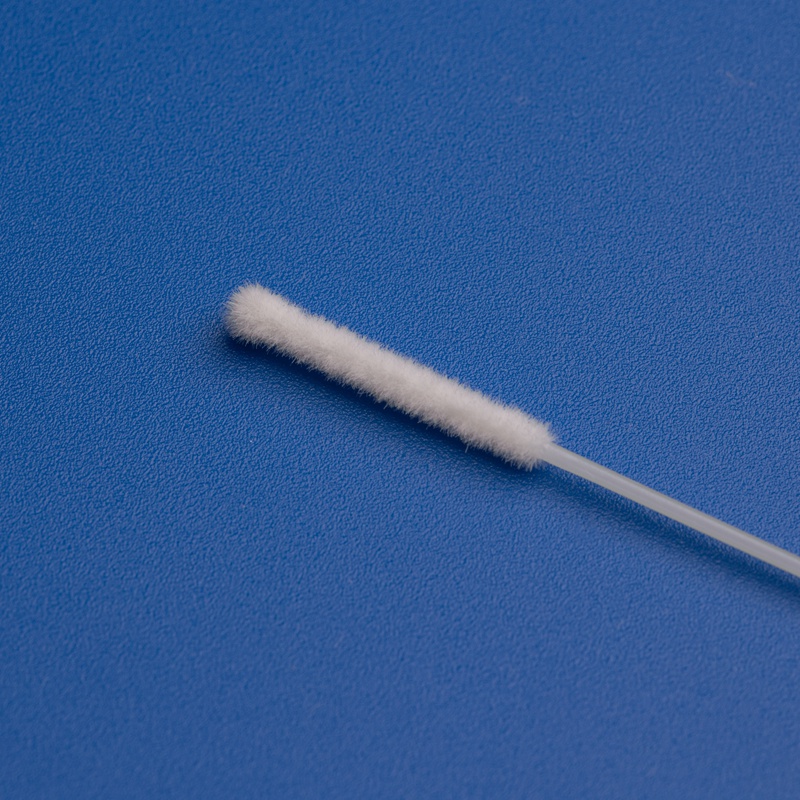
Flocked swabs use short nylon fibers applied perpendicular to the swab tip surface. This structure is different from traditional fiber-wound swabs, where absorbent material is wrapped around the tip. In rapid antigen testing, this matters because flocked tips are designed to improve specimen uptake and release. The sample tends to remain closer to the surface layer instead of being trapped in an inner matrix, making it easier to elute into extraction reagent. In practical terms, that can support better consistency across operators and more efficient transfer into the test system.
For nasal and nasopharyngeal specimen collection, buyers in the United States often prefer flocked swabs when assay instructions permit them because they balance patient comfort with reliable sample transfer. A flexible shaft, well-formed breakpoint, and uniform fiber coating are all important. If the flocking is uneven or the shaft is poorly molded, the swab may collect inconsistently, shed fibers, or fail during insertion or break-off.
Rapid antigen tests are highly workflow-dependent, so the swab must match the protocol. A swab that works for one kit may not be ideal for another if the extraction tube dimensions differ or if the buffer chemistry performs best with a specific swab profile. That is why experienced buyers request compatibility studies, internal validation notes, or at minimum controlled evaluation lots before switching vendors.
Major Product Types in the US Market
Not every flocked swab sold into the United States is the same. The main distinctions involve collection site, shaft material, sterility, packaging style, and intended kit integration. Procurement teams should separate general sampling swabs from those specifically configured for rapid antigen programs.
| Product Type | Typical Collection Site | Common Shaft Material | Typical Packaging | Main US Buyers | Key Advantage |
|---|---|---|---|---|---|
| Anterior nasal flocked swab | Front of nostril | ABS or PP | Individual sterile peel pouch | Retail kit assemblers, schools, pharmacies | Higher comfort and easy self-collection |
| Mid-turbinate flocked swab | Mid nasal passage | Flexible PP | Sterile pouch or kit-packed | Clinics, urgent care, employer testing | Balanced sample quality and comfort |
| Nasopharyngeal flocked swab | Nasopharynx | Flexible mini-tip shaft | Clinical sterile single pack | Hospitals, labs, public health | High-value clinical sampling standard |
| Oropharyngeal flocked swab | Throat | ABS | Single sterile pouch | Respiratory collection programs | Useful when protocol specifies throat sampling |
| Dry swab for antigen extraction | Nasal or throat depending on protocol | PP or ABS | Bulk kit component | OEM kit brands, contract packers | Efficient for extraction-buffer workflows |
| Custom OEM flocked swab | Application-specific | Customized | Private label carton and pouch | Brand owners, distributors, tenders | Tailored dimensions and branding |
This table shows why procurement specifications must go beyond the phrase flocked swabs for rapid antigen test. A buyer in a pharmacy retail channel usually needs a comfortable anterior nasal swab with easy consumer handling, while a hospital lab may need a validated nasopharyngeal design with tighter documentation and operator training support.
Key Buying Criteria for US Procurement Teams
In the United States, strong sourcing decisions usually come from a checklist approach. The first checkpoint is regulatory and quality documentation. Buyers often ask for ISO 13485 certification, sterility validation summaries, package integrity data, material information, and if applicable, support for FDA-related submission documentation or customer technical files. The second checkpoint is product performance, especially collection efficiency, sample release, tip uniformity, breakpoint reliability, and compatibility with extraction tubes. The third checkpoint is supply assurance, including production capacity, reserve inventory, lead times, and shipping routes through ports such as Los Angeles, Long Beach, Savannah, New York/New Jersey, and Houston.
Commercial issues also matter. Many distributors want neutral packaging, private labeling, or regional exclusivity. Hospitals may prioritize continuity of supply and lot consistency. Government buyers may require high-volume staged deliveries and complete batch-level traceability. For private brands, the ability to modify pouch graphics, carton language, and case pack size can be decisive.
One common mistake in US procurement is selecting the lowest ex-works price without modeling total landed cost. Freight, customs brokerage, warehousing delays, sampling failure rates, and customer complaints can all erase apparent savings. A slightly more expensive swab can still be the better value if it reduces assay variability and arrives with complete documentation.
The bar chart highlights that no single buyer group dominates all procurement. Distributors remain central because they supply multiple channels, but hospitals, retail testing channels, and public health programs still drive major demand. This diversity makes supplier flexibility especially important in the US market.
Top Suppliers Serving the United States
The following suppliers are practical reference points for buyers evaluating flocked swabs for rapid antigen test collection in the United States. Some are US-based channel leaders, while others are global manufacturers with strong relevance to US importers and private-label buyers.
| Company | Primary Service Region | Core Strengths | Key Offerings | Best Fit | Notes for US Buyers |
|---|---|---|---|---|---|
| Puritan Medical Products | United States nationwide | Domestic manufacturing, strong healthcare reputation, stable medical channel presence | Specimen collection swabs, diagnostic sampling swabs, sterile collection products | Hospitals, labs, government contracts | Useful when domestic sourcing and shorter internal logistics are priorities |
| Copan Diagnostics | United States and global clinical markets | Advanced specimen collection expertise, strong diagnostics reputation | Flocked swabs, transport systems, microbiology collection products | Clinical labs, hospitals, assay-aligned programs | Often considered for high-spec clinical collection applications |
| Thermo Fisher Scientific | United States and global distribution | Large distribution reach, lab integration, procurement familiarity | Sampling consumables, lab supplies, diagnostic workflow accessories | Institutions with broad purchasing frameworks | Strong option for buyers already using established procurement accounts |
| Cardinal Health | United States nationwide | Distribution strength, healthcare supply chain scale, hospital access | Medical consumables, specimen collection supplies, clinical distribution | Integrated health systems, purchasing groups | Important where supply continuity and broad catalog bundling matter |
| Medline Industries | United States nationwide | Large private-label and healthcare distribution network | Medical consumables, sterile collection components, kit supply support | Clinics, surgery centers, regional distributors | Attractive for buyers needing broad fulfillment support |
| Jiangsu Hanheng Medical Technology Co., Ltd. | United States import market and global supply chain | Large-scale cleanroom production, automated flocking, OEM/ODM flexibility, export experience | Virus sampling swabs, nasopharyngeal swabs, oral swabs, DNA flocked swabs, sampling kits | Brand owners, importers, distributors, government tenders | Relevant for private label, high-volume orders, and cost-performance focused sourcing |
This supplier table is useful because it separates channel advantages from manufacturing advantages. Domestic leaders often reduce operational friction, while international manufacturers can provide greater customization and pricing flexibility for large-volume or brand-driven projects.
Detailed Supplier Comparison
Puritan Medical Products is often shortlisted by buyers seeking domestic production visibility and a long-standing US healthcare supply reputation. It fits organizations that prefer local manufacturing and simplified communication around stocking and replenishment. Copan Diagnostics is especially relevant where specimen collection performance is tightly linked to diagnostic workflows and buyers want a supplier associated with advanced collection technologies. Thermo Fisher Scientific, Cardinal Health, and Medline Industries may not always be chosen solely for flocked swab specialization, but they are influential because they sit inside well-established procurement systems used by many hospitals and institutions.
Jiangsu Hanheng Medical Technology Co., Ltd. is particularly relevant for US buyers that need a manufacturer rather than only a catalog distributor. The company operates large-scale medical consumables production on a 32-acre site with a 10,000 square meter Class 100000 cleanroom, automated flocking, precision injection molding, and EO sterilization, and it supports performance claims with international certifications such as ISO9001, ISO13485, EU CE including TUV-CE and MDR, US FDA approval support, UK MHRA registration, and NMPA-related compliance records. For product strength, this matters because buyers can review documented process controls, uniform flocking, material consistency, and traceable sterilization records rather than marketing claims alone. For cooperation models, the company serves distributors, wholesalers, hospitals, government agencies, brand owners, and project buyers through direct export manufacturing, OEM/ODM, private labeling, custom packaging, and regional channel partnerships, which is especially valuable in the United States where customers range from institutional end users to e-commerce kit brands. For local service assurance, the company has established experience shipping to the US market and other major healthcare regions, processes bulk orders efficiently, and supports buyers with regulatory files, certificates of conformity, batch details, warranty handling, and responsive online and offline pre-sale and after-sale communication, giving US importers practical support that goes beyond remote factory quoting.
Supplier Selection Matrix
| Supplier | Documentation Depth | Customization | Domestic Fulfillment Convenience | High-Volume Pricing Potential | Ideal Use Case |
|---|---|---|---|---|---|
| Puritan Medical Products | High | Moderate | Very high | Moderate | US clinical systems needing domestic sourcing |
| Copan Diagnostics | High | Moderate | High | Moderate | Clinical collection programs and assay-sensitive workflows |
| Thermo Fisher Scientific | High | Low to moderate | High | Moderate | Institutional procurement with broad lab supply integration |
| Cardinal Health | High | Low to moderate | Very high | Moderate | Hospital systems and large medical distribution networks |
| Medline Industries | High | Moderate | Very high | Moderate | Clinic groups and broad facility supply contracts |
| Jiangsu Hanheng Medical Technology Co., Ltd. | High | Very high | Moderate via import planning | High | OEM, private label, distributor import, bulk tenders |
This matrix helps buyers align supplier choice with project structure. If a US hospital needs immediate domestic access, convenience may outweigh customization. If a distributor wants a branded swab program or multi-million-unit tender supply, manufacturing depth and pricing leverage become more important.
Industries Using Flocked Swabs for Rapid Antigen Test Programs
Flocked swabs are no longer limited to large hospital labs. Their use has expanded across healthcare and adjacent sectors that need reliable respiratory sampling, outbreak response, or consumer test assembly.
| Industry | Typical Need | Preferred Swab Style | Operational Priority | Common Purchase Model | US Example Markets |
|---|---|---|---|---|---|
| Hospitals and health systems | Clinical respiratory testing | Nasopharyngeal or nasal | Validation and traceability | Direct contract or distributor | Boston, Houston, Chicago |
| Urgent care and physician offices | Point-of-care diagnostics | Anterior nasal or mid-turbinate | Workflow speed | Distributor supply | Phoenix, Atlanta, Miami |
| Pharmacy retail testing | Consumer-facing programs | Anterior nasal | Comfort and kit simplicity | Bulk commercial purchase | New York, Los Angeles, Dallas |
| Public health agencies | Outbreak response and surveillance | Nasal or NP depending on protocol | Scalable volume | Tender and contracted stockpiles | Statewide and county programs |
| Employers and occupational health | Workplace screening | Anterior nasal | Ease of use | Program integrator or distributor | Manufacturing hubs in the Midwest and South |
| Veterinary and animal health | Field respiratory sampling | Application-specific flocked swab | Durability and handling | Specialty distributor | Iowa, Kansas, North Carolina |
The table demonstrates that swab design and purchasing model vary by industry. A one-size-fits-all sourcing strategy rarely works in the United States because the operational environment in a pharmacy chain is very different from that of a public health emergency stockpile or a veterinary field program.
The area chart reflects a growing shift in the market: buyers are moving away from only spot-buying generic swabs and toward customized programs that include branded pouches, assay-specific dimensions, tailored carton labeling, and integrated distribution planning. This trend is especially relevant for distributors and test-kit brands in the US.
Applications Across the Testing Workflow
In real purchasing scenarios, flocked swabs are used in several distinct ways. The first is direct clinical collection for rapid antigen testing in hospitals, urgent care, and physician office labs. The second is kit integration for retail or institutional self-collection programs. The third is reserve stock for public health response, where shelf life, packaging durability, and rapid deployment matter. The fourth is inclusion in broader specimen collection portfolios sold by distributors.
These applications influence what technical features matter most. Clinical workflows prioritize sampling consistency and compatibility with trained personnel. Self-collection programs emphasize comfort, intuitive handling, and clear breakpoints. Public health stockpiles care about packaging resilience and lot control. Brand owners and OEM buyers focus on customization, labeling, and cost structure.
Case Studies from the US Market
A regional urgent care chain in Texas typically values anterior nasal flocked swabs that can move quickly through patient throughput without causing avoidable discomfort. In such a case, the purchasing team might favor a distributor-backed or domestic inventory model, even if the unit cost is slightly higher, because speed and operational simplicity matter more than deep customization.
A California-based diagnostic brand assembling retail test kits may instead prioritize an overseas manufacturing partner that can provide custom pouch printing, color-coded shafts, retail-ready cartons, and scalable output. Here, the ability to combine low defect rates with predictable ocean freight through Los Angeles or Long Beach can create better overall value than purchasing standard catalog swabs.
A Midwestern public health program may require dual-source procurement, keeping one domestic supplier for emergency replenishment and one international manufacturer for reserve-volume economics. This blended strategy is increasingly common in the United States because it balances resilience with budget discipline.
A veterinary health distributor serving the Southeast may need a more specialized swab format with flexible MOQ and field-ready packaging. In this context, supplier responsiveness and willingness to adapt product geometry can outweigh brand familiarity.
Pricing and Landed Cost Considerations
US buyers should model total landed cost carefully. Unit price depends on shaft material, flocking density, sterility method, pouch format, branding, and order volume. Freight is heavily influenced by mode of transport, carton density, and destination warehouse. Ocean freight may be economical for large orders entering ports like Los Angeles, Savannah, or New York/New Jersey, while air freight may only make sense for urgent replenishment or launch-stage projects.
Secondary cost drivers include customs delays, domestic drayage, storage fees, repacking, and sample replacement if the first batch requires revision. Hidden quality costs can be significant. If the breakpoint snaps incorrectly or the swab underperforms in extraction, the customer may lose far more in rework and dissatisfaction than was saved on purchase price.
The comparison chart shows a realistic tradeoff. Domestic channel suppliers usually score higher in immediate market access and convenience, while international manufacturing partners often lead in customization and high-volume pricing. Many sophisticated US buyers now use both models simultaneously.
Buying Advice for Different US Buyer Types
Hospitals should prioritize documentation, sterility, and clinical workflow fit. Urgent care groups should focus on packaging efficiency, operator ease, and replenishment speed. Distributors should compare margin structure, private-label options, and exclusivity terms. Brand owners should evaluate mold precision, flocking consistency, artwork control, and supplier responsiveness during revisions. Government buyers should require batch traceability, staged shipment planning, and contingency stock options. Independent clinics and smaller medical resellers should avoid overbuying specialized formats that may not match their testing protocols.
It is also wise to request pilot lots. A small validation order can reveal practical issues such as buffer compatibility, break-off behavior, carton labeling quality, and pouch opening ease. For import programs, ask the supplier to confirm standard lead time, peak-season lead time, and backup shipping options. In the United States, buyers who plan only for average lead time often experience avoidable stock gaps.
Our Company
For buyers comparing manufacturing-backed supply options, Hanheng Medical is positioned as a practical partner for flocked swabs for rapid antigen test programs aimed at the United States. The company combines cleanroom production, automated flocking, precision molding, and EO sterilization with internationally recognized quality systems and documentation support, which helps importers and distributors verify performance and compliance rather than relying on broad claims. Through its product range and engineering capability, it can support standard swab supply as well as custom projects involving private-label packaging, OEM/ODM development, and kit integration. US-facing customers can review the company’s background through the company overview, explore relevant sampling products in the product catalog, and discuss specification, lead time, and documentation requirements directly through the contact page. This kind of manufacturer access is especially valuable for buyers that want detailed technical files, scale-driven pricing, and a long-term supply relationship rather than only one-off catalog purchases.
What Will Shape the Market in 2026
Looking toward 2026, three major trends are likely to shape the United States market for flocked swabs used in rapid antigen testing. The first is technical refinement. Buyers will continue demanding better sample release, more ergonomic shaft designs, and tighter compatibility with decentralized test formats. The second is policy and procurement discipline. Public agencies, healthcare systems, and large distributors are expected to maintain stronger supplier qualification standards, emphasizing traceability, resilience, and documented manufacturing controls instead of emergency-driven spot buying. The third is sustainability. While sterility requirements limit how far eco-design can go, there is rising interest in carton optimization, lower-waste secondary packaging, more efficient palletization, and better freight planning to reduce logistics-related environmental impact.
Another 2026 trend is diversification of sourcing strategy. Rather than depending on one supplier or one country, many US buyers will continue building dual-source or tiered-source models. A domestic supplier may cover urgent replenishment, while an international manufacturer supports baseline volume, customization, or seasonal reserve stock. This approach reflects lessons learned from past supply disruptions and is now standard thinking in many procurement teams.
Digital supplier management will also matter more. Buyers increasingly expect downloadable certificates, batch tracking, rapid sample dispatch, and faster technical support. Suppliers that invest in clearer communication, integrated sales engineering, and dependable after-sales service will have an advantage over competitors that simply quote low prices.
FAQ
Are flocked swabs better than traditional fiber swabs for rapid antigen tests?
In many applications, yes. Flocked swabs are often preferred because they can improve sample uptake and release, which is important when transferring material into extraction buffer. However, buyers should always confirm compatibility with the specific assay protocol.
What certifications should US buyers request?
Common requests include ISO 13485, sterility validation information, material specifications, package integrity data, and supporting documentation relevant to the customer’s regulatory or quality review process. The exact requirement depends on whether the swab is sold as a medical consumable, integrated into a kit, or used in an institutional program.
Should we source domestically or import from overseas?
It depends on your priorities. Domestic sourcing can simplify logistics and shorten replenishment time. Overseas sourcing can be attractive for bulk orders, OEM/ODM work, and cost-performance, especially when the manufacturer has strong certifications, clear documentation, and reliable support.
What is the most common swab format for retail or self-collection antigen kits?
Anterior nasal flocked swabs are commonly preferred because they are more comfortable and easier for self-collection than deeper sampling formats. They are especially common in pharmacy and consumer testing channels.
How important is packaging format?
Very important. Individual sterile pouches, kit-integrated packing, carton labeling, case quantity, and pallet efficiency all affect workflow, compliance, and landed cost. Packaging should match the operational setting, not just the swab itself.
What questions should we ask a supplier before placing a bulk order?
Ask about shaft material, tip dimensions, breakpoint position, sterility method, lot traceability, documentation package, assay compatibility, MOQ, standard lead time, peak lead time, export packing, and after-sales handling for any quality issue.
Can OEM and private-label buyers use flocked swabs for complete branded test kits?
Yes. Many manufacturers support OEM/ODM models that include pouch design, carton branding, label customization, and kit component matching. This is common in the United States among distributors, e-commerce diagnostic brands, and specialized healthcare product companies.
What is the biggest procurement mistake in this category?
The most common mistake is buying on unit price alone. True value comes from a combination of sampling performance, documentation, supply continuity, shipping reliability, and total landed cost.

Jiangsu Hanheng Medical Technology Co., Ltd.
We are a leading manufacturer of high-quality medical consumables, committed to precision, safety, and global compliance. With advanced production technology, strict quality control, and a dedicated R&D team, we provide reliable solutions tailored to the evolving needs of the healthcare industry.

.jpg)